We've been showing people around Morocco since 1998. A lot of our guests come from New York, Florida, Texas and California, and funny enough, almost all of them ask the same handful of questions before they book. How many days is enough? Is it safe? Do I need a visa? Is the desert really worth that long drive?
So we figured we'd answer them in one place, the way we'd explain it to a friend. If you'd rather just talk it through with a real person, send us your dates and one of us will get back to you.
Flying over from the States
Good news first: you don't have to connect through Europe anymore. Royal Air Maroc runs nonstops to Casablanca from JFK, Washington Dulles and Miami, and since June 2026 there's one from Los Angeles too. (That's the first nonstop ever between the West Coast and Africa, which is kind of a big deal.) There's also a United flight from Newark straight to Marrakech. It's seasonal, though, so don't fall in love with it until you've seen the schedule.
Coming out of New York, Washington or Miami, figure on roughly seven hours nonstop. The usual pattern is an evening departure and a landing somewhere around sunrise, give or take. Our advice? Eat before you board, skip the movie, and sleep.
So where should you land? Most US flights come into Casablanca, and there's no need to hang around there. Your tour can start right at the airport, like our 10-day Casablanca desert tour does. If you can find a flight straight into Marrakech, though, grab it. That's where most of the classic routes begin, including our 8-day tour from Marrakech.
Here's a trick a lot of travelers miss: book an open-jaw ticket. Land in Casablanca, fly home from Marrakech, or the other way round. It saves you a whole day of backtracking.
And go easy on yourself on day one. Jet lag hits harder than people expect. For guests coming from the US, we keep the first afternoon light on purpose: a short walk, a tagine, an early night.
Visas, money and the other boring (but important) stuff
Visa. You don't need one. US passport holders get up to 90 days. Just make sure your passport covers the whole trip. We'd go for six months of validity so no airline agent gives you a hard time at check-in.
Money. Morocco uses the dirham, and here's the quirk: you can't really get it before you leave. Don't worry about it. You'll walk past a row of ATMs right after customs. Your riad will probably take a card, and so will the fancier restaurants. The souks, though, and the taxis, and that guy squeezing fresh orange juice in Jemaa el-Fnaa for a few dirhams? They'll want cash.
Tipping. This one won't feel foreign at all, because Moroccans tip too. We usually tell guests to round up for coffee, leave about 10% when they sit down for a meal, and keep an envelope aside for the driver and guides on the last day.
Plugs. The same round two-pin plugs you'd find in France or Spain (types C and E), running on 220 volts. Bring an adapter. Your phone and laptop chargers will almost certainly cope with the voltage, but check your hair dryer.
Phone. Set up an eSIM before you fly and you'll have data the second you switch off airplane mode.
Language. Walk through any souk and you'll catch Arabic, Amazigh (Berber) and French, sometimes all in one sentence. Your English will get you through the riads and the big sights without a problem. Up in a mountain village? A smile and some pointing go a long way. Every one of our guides speaks it, so you're covered.
Time. Lunchtime in New York is usually late afternoon in Marrakech, five hours later for most of the year and six in the US winter. Fair warning: Morocco shifts its clocks around Ramadan as well. It catches plenty of visitors off guard, so check before you book trains or flights.
Clothes. Leave the fancy outfits at home. Loose linen pants, a light scarf and a shirt with sleeves will make you feel at ease in the medinas, and you'll get fewer stares in the villages too. And pack something warm for the desert. Even after a baking-hot afternoon, it gets properly cold out there at night.
So... is Morocco safe for Americans?
Short answer: yes, for the vast majority of travelers. The US State Department rates Morocco Level 2, "Exercise increased caution", last updated in September 2026, mainly because of the general risk of terrorism. Lots of popular destinations carry that same rating, and Morocco welcomes millions of visitors every year.
What actually rattles first-timers is much more ordinary. A seller in the souk who won't take the first no. A friendly stranger who "helps" you find your riad and then wants a tip. Getting completely lost in the Fes medina, which has thousands of lanes, so that one's fair enough. A smile and a "la, shukran" (no, thank you) sorts out most of it. Agreeing on the taxi fare before you get in sorts out the rest.
This is a big reason our American guests go private. Your driver knows the routine, knows what to skip, and is always a phone call away. One guest of ours landed two days late, and the airline had lost his bag on top of that. His driver, Salah, tracked the luggage down for him in Fes. Not exactly in the job description, but that's how our team works.
There's more on this in our guide to whether Morocco is safe for couples and honeymooners. Before you fly, sign up for the State Department's STEP program so the embassy can reach you if it ever needs to.
When to go
If we could pick your dates for you, we'd go with spring (March to May) or fall (September to November). You get T-shirt afternoons, sweater evenings, and a desert that's actually pleasant to be in.
- Spring (Mar–May): Warm days, green valleys, wildflowers in the Atlas. Good for first-timers, hiking, birding.
- Summer (Jun–Aug): Hot. Marrakech often tops 100°F and the desert gets hotter. Good for the coast, the mountains, early starts.
- Fall (Sep–Nov): Warm days, cooler nights, fewer crowds than spring. Good for desert tours, Thanksgiving trips.
- Winter (Dec–Feb): Mild cities, snow on the Atlas, freezing desert nights. Good for Christmas and New Year trips, smaller crowds.
If you only have school holidays, don't worry. Thanksgiving week, Christmas and spring break all work well. Just pack warm layers for the camp.
Oh, and a heads-up about Ramadan. In 2027 it runs from about mid-February into mid-March. You can absolutely still travel then, and some of our guests love it. A few cafés stay shut until sunset, but after the evening call to prayer the whole city seems to wake up at once. For the full picture, read Morocco in all four seasons and our post on how hot Morocco really gets.
How many days do you need?
If you're flying all the way from the States, give Morocco at least a week. Ten days is our favorite for first-timers. Here's how the main options compare.
One week: the classic loop
Seven days covers the big three: Marrakech, the Sahara and Fes. It's the most popular trip with our American guests, and our Morocco 7 day tour is built around it. You'll cross the High Atlas, sleep in a desert camp and get lost (happily) in the Fes medina.
Want one more day to breathe? The 8-day tour from Marrakech adds that slack. If you're flying in through the north, try the 8-day Tangier to Marrakech tour, with the blue city of Chefchaouen on the way.
Ten days: the sweet spot
Ten days lets you slow down. You add Casablanca and Rabat, extra time in the gorges and valleys, and a night or two with nothing planned. Our Morocco 10 day tour from Casablanca starts right where most US flights land. There's also a day-by-day breakdown of a 10-day route on our blog.
Twelve days to two weeks: the whole country
Got two weeks? Then you can finally stop rushing. That's enough time for the imperial cities, the Sahara, the mountains and a few lazy days on the Atlantic coast. Three trips we'd point you to: our Morocco 12 day tour, the 14-day Morocco private tour, or the two-week Morocco grand tour, which finishes on the Atlantic coast.
Short on time?
Five days still works if you're adding Morocco to a Europe trip. The 5-day tour from Fes to Marrakech crosses the desert and the Dades Valley in one go. You can browse every option on our Morocco tour packages page.
Don't skip the Sahara
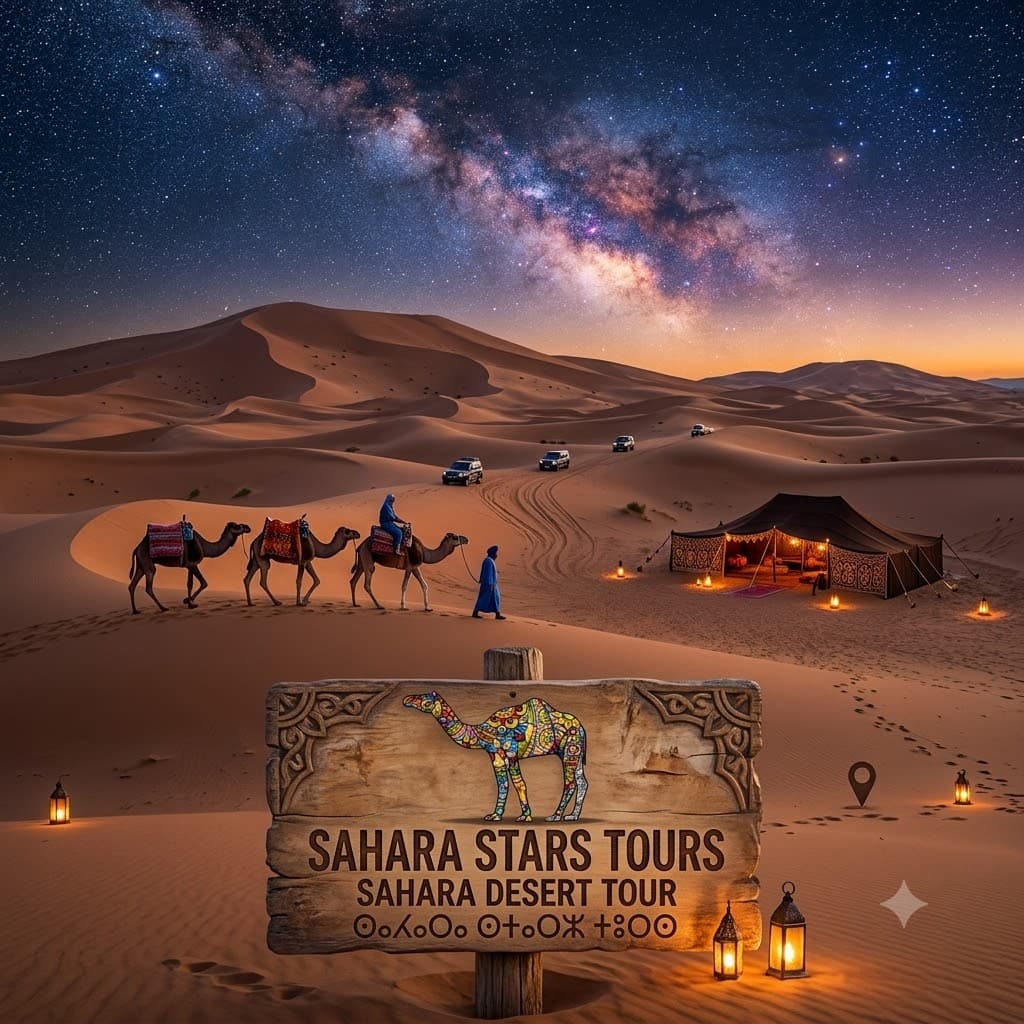
Ask our guests what they remember most, and nine times out of ten it's the desert. You ride a camel into the Erg Chebbi dunes near Merzouga as the sun drops. Dinner is by the fire, there's drumming, and then the sky fills with more stars than you've ever seen.
Here's the catch: Merzouga is a long way from everything. It's about 9 hours by road from Marrakech and around 7 from Fes. That's why we don't recommend a desert day trip. Plan at least three days so the drive becomes part of the adventure, with the Atlas passes, Ait Ben Haddou and the Todra Gorge along the way.
The most popular Sahara desert tour options:
- 3-day private Sahara tour from Marrakech to Merzouga, the quickest way to see the dunes from Marrakech
- 5-day Merzouga desert tour from Marrakech, with a slower pace and more stops
- 3-day tour from Fes to Marrakech via the desert, if you're already heading south
- 9-day tour from Tangier via the Merzouga desert, for a north-to-south trip
Wondering if it's worth the long drive? We answered that in Is a Sahara desert tour worth it? Our list of top things to do around Merzouga is a good next read too.
Tours for special interests
Not everyone comes for the souks and the dunes. Three of our tours are especially popular with American travelers who have a specific passion.
Jewish heritage of Morocco
Morocco's Jewish story goes back more than two thousand years, and it isn't tucked away in a textbook. It's right there in the narrow streets of the old mellahs in Fes and Marrakech, in quiet synagogues that have been carefully restored, and in Casablanca's Museum of Moroccan Judaism. Many US families come looking for their own roots. Our Morocco Jewish tour from Casablanca runs for 8 days. Tell us about kosher meals or Shabbat and we'll plan around them. For background, see our guide to Jewish heritage in Morocco.
Birdwatching
Morocco is one of the best birding countries near Europe. Birders come for species that are hard to find anywhere else, like the Northern Bald Ibis on the coast near Agadir. Our Morocco birding tours cover coast, mountain and desert habitats. For a longer trip, try the 8-day birding tour from Casablanca to Marrakech or the 10-day birding tour from Fes to the Sahara. Our post on where to go on an 8-day birdwatching trip has the route details.
Fossil hunting
The area around Erfoud, near the Sahara, was once the bottom of an ancient sea. Today it's full of trilobites and ammonites, and it's a dream for collectors and curious kids. Our Morocco fossil tour takes 3 days from Marrakech. Read the ultimate guide to fossil hunting in Morocco before you go.
Private tour or do it yourself?
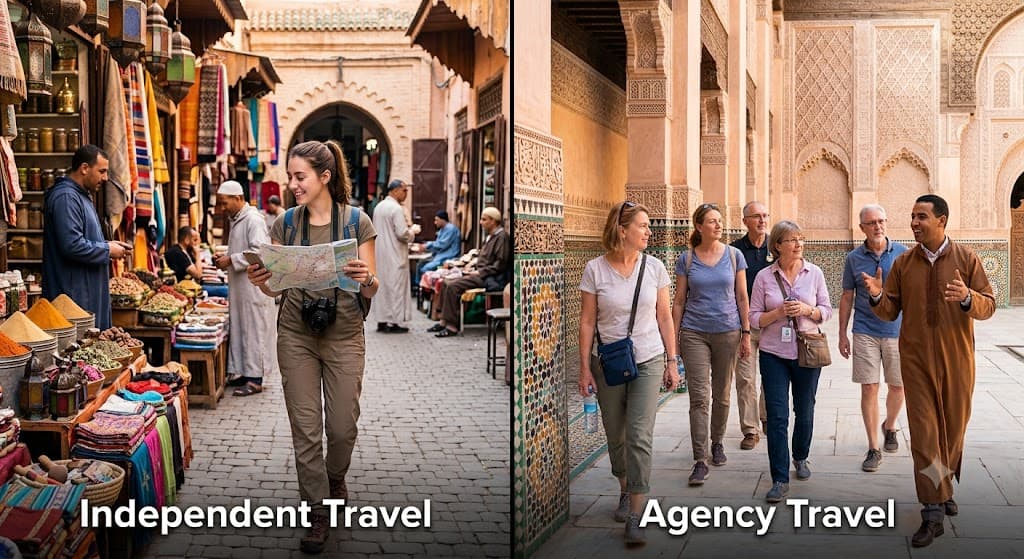
You can travel Morocco on your own. Trains link Casablanca, Rabat, Fes, Tangier and Marrakech, and they're comfortable. Past the train lines, though, things get harder. There's no train to the Sahara, the mountain roads are long, and the best kasbahs and gorges are spread out.
That's why most American visitors go with Morocco private tours. You get your own driver and vehicle, a schedule that bends around you, and hand-picked riads instead of chain hotels. Nobody's waiting on a bus full of strangers. We compared both options in Should you visit Morocco with a travel agency or on your own?
What will it cost?
We get asked this a lot, and the real answer is: it depends. Mostly on how long you stay, when you travel, how fancy you want your riads and desert camp to be, and how many of you are coming. Bring a few friends along and the per-person price drops, since you're sharing the same car and driver. Book your flights 3 to 5 months out for spring and fall, when demand from the US is highest. Our post on what's included in a Morocco tour package explains what's covered and what isn't.
Ready to start planning?
Send us a quick message. Dates, how many of you, and the stuff you keep picturing when you think of Morocco (camels? a cooking class? mint tea on a rooftop?). We'll sketch out a trip around it. Asking is free. Plan your trip here, or contact us on WhatsApp or email. We reply fast, even across the time difference. Curious who we are? Meet the team on our About Us page.
Frequently asked questions
Do US citizens need a visa for Morocco? Nope. With a US passport you can stay up to 90 days, no visa needed. Just double-check the expiry date before you pack.
How long is the flight from the USA to Morocco? Around seven hours, if you take a nonstop from New York to Casablanca. Nonstops also leave from Washington, Miami and Los Angeles, and United flies Newark to Marrakech in season.
How many days do I need in Morocco? We'd say a week at minimum, which covers Marrakech, the Sahara and Fes. Most first-timers we host are happiest with ten. Got two weeks? Throw in the coast and Chefchaouen up north.
Is Morocco safe for American tourists? For most people, yes. The State Department has it at Level 2 ("Exercise increased caution"). In our experience the hassles guests actually run into are small, like pushy sellers, and having a guide with you takes care of most of that.
What is the best month to visit Morocco from the US? Ask our guides and they'll say April, May, October or November. It's warm but not scorching, and you won't freeze in the desert camp at night.
Can I use US dollars in Morocco? Not really. Locals pay in dirhams, and so will you. Hit an ATM at the airport and hang on to the small notes, because you'll want them for tips and haggling.
Are your Morocco tours private? Yes, all of them. No strangers on a bus, just your crew and your own English-speaking driver. Want to swap a day or add a stop? We'll change it.
Enjoyed this article?
Share it with fellow Morocco enthusiasts!